Table of Contents
Why Is A Power Capacitor Acting Up?
It is one of the most annoying sounds in the electrical world: the low, unhappy hum of a motor that wants to start but just can’t. You hit the button, the lights dim for a second, and then… nothing. Or maybe the breaker trips immediately. Before you go tearing apart the motor or blaming the wiring, you should probably look at the power capacitor.
These components are like the short-term batteries of the industrial world, giving motors the kick they need to get moving or cleaning up the power factor on a messy line. But they don’t last forever. They dry out, they short internally, or they just get tired. Testing one isn’t exactly rocket science, but it does require a bit of respect for the electricity involved. It’s not quite as simple as checking a fuse, but with the right approach, you can usually figure out if it’s a dud in about five minutes.

Safety First
Before you even think about touching a screwdriver to a terminal, remember what a power capacitor actually does: it stores energy — that is its whole job. Even if you have turned off the main breaker and locked out the panel, a Three Phase Capacitor bank or a single power capacitor can still be holding a charge lethal enough to ruin your day—or your life. Experienced technicians have a healthy fear of these things. The first rule is always to discharge it. While modern power capacitors usually have internal discharge resistors that bleed off the voltage after a minute or so, you should never trust them. You need to manually bridge the terminals with a proper discharge resistor (not an uninsulated tool), and be aware that in a three phase power capacitor arrangement each phase can retain charge independently. Once you have positively verified with a meter that the energy is gone, then—and only then—can you proceed.
The Visual Inspection: Look Before You Meter
Honestly, half the time you don’t even need a meter to tell that a power capacitor is toast. The physical signs are usually pretty obvious if you know what to look for.
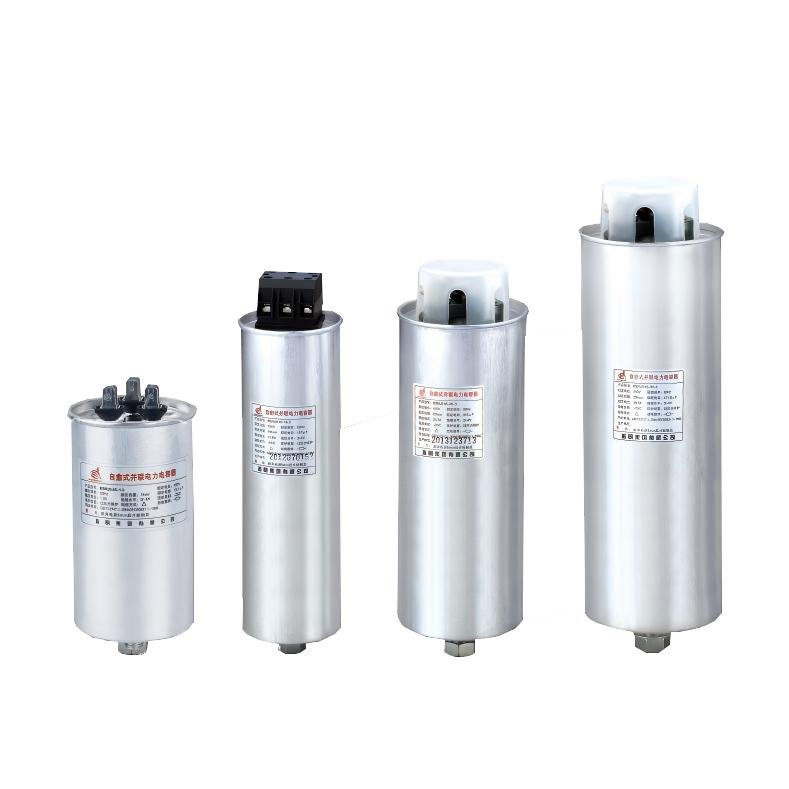
Start by just looking at the shape of the can. Most industrial power capacitors are housed in aluminum or steel cases. If the case looks swollen, rounded, or “pregnant,” it’s bad. No testing required. That swelling comes from internal pressure building up as the dielectric material breaks down and releases gas. The safety mechanism has likely already triggered, disconnecting the internals to prevent an explosion.
Also, look for oil. Many older or larger units are oil-filled. If you see a sticky, oily residue around the terminals or at the base of the unit, it has sprung a leak. If the air around it smells acrid—sort of like burnt plastic or chemicals—that’s another dead giveaway. If it looks gross, just replace it.
Testing Power Capacitor with a Multimeter
If it looks fine on the outside, you have to look at what’s happening on the inside. This is where your digital multimeter comes in. Ideally, you want a meter that has a dedicated capacitance mode.
Step 1: Isolate the Component You have to take the power capacitor out of the circuit. If you try to measure it while it’s still connected to the motor windings or other wiring, your meter will read the rest of the circuit, not the capacitor. Disconnect at least one side, but taking it all the way out is usually easier.
Step 2: The Discharge (Again) Yes, do it again. Just touch the probes together or bridge the terminals one last time. Residual voltage can blow the fuse in your expensive meter.
Step 3: The Measurement Set the meter to “Capacitance.” Touch the red probe to one terminal and the black to the other. It doesn’t matter which way around (polarity) for AC capacitors, which is what most power capacitors are.
Now, wait. The meter has to charge the unit slightly to get a reading, so it might take a few seconds for the numbers to settle.
Interpreting the Numbers
This is where people get confused: what number is “good” for a high voltage power capacitor? Look at the label on the side of the can — it will give you a rating in microfarads (µF or MFD) and a tolerance percentage. A common rating might be “50µF ±5%,” which means any reading between 47.5µF and 52.5µF is perfectly fine. If your meter reads 49µF, put the High Voltage Power Capacitor back in service; it’s healthy. If the reading is perfect but the system still acts up, the problem may not be the can itself but the capacitor contactor failing to engage or having burnt contacts. If the meter reads zero, it’s an open circuit. If it reads extremely low, say 15µF, the dielectric has degraded and the capacitor can no longer provide the necessary phase shift or energy storage.
The Old-School Resistance Test
What if your multimeter is basic and doesn’t have a fancy capacitance setting? You can still do a rough “Go/No-Go” test using the Ohms (resistance) setting. It won’t tell you how strong the power capacitor is, but it will tell you if it is shorted or completely open.
Set the meter to a high resistance range (like 20k Ohms). Put the probes on the terminals.
- The behavior you want to see: The resistance should start low (near zero) and then climb rapidly towards infinity (OL) as the battery in your meter charges the capacitor.
- The behavior you don’t want: If it stays at zero, it’s shorted (dead). If it stays at “OL” immediately without climbing, it’s open (also dead).
It’s a crude method, but if you are stuck in a remote pump house with a cheap meter, it works in a pinch.
When to Call It Quits
There is often a temptation to keep using a power capacitor that is “borderline.” Maybe it measures 40µF and it’s supposed to be 50µF. You might think, “Well, it’s still working a little bit.”
Don’t do it. A weak capacitor puts extra strain on the motor windings. The motor runs hotter, draws more amps, and eventually, you trade a $50 capacitor problem for a $500 motor rewind job. It just isn’t worth the risk.
Testing is about confidence. Once you verify the numbers, you stop guessing. You either put it back knowing it’s solid, or you toss it in the recycling bin and get a fresh one. It removes the mystery from the machine.