If you have ever been brave enough to unscrew the casing of an old desktop computer or a heavy amplifier—strictly after unplugging it, of course—you have probably noticed them immediately. Amidst the flat landscape of green circuit boards and tiny soldered chips, there are usually a few distinct, tower-like structures standing tall. These are the capacitors. Specifically, within the context of energy conversion, the role of a power capacitor is fundamental, yet it often gets taken for granted until something goes wrong with a loud pop or a puff of smoke.
It is interesting to observe that while processors get all the glory for speed and performance, the power supply is the unsung hero doing the heavy lifting, and the capacitor is its muscle. Without it, the electricity flowing into sensitive electronics would be too erratic, too noisy, and simply too unstable to be useful. It acts as a buffer, a reservoir, and a filter all at once, bridging the gap between the raw, alternating current coming from the wall outlet and the precise direct current that modern devices crave.
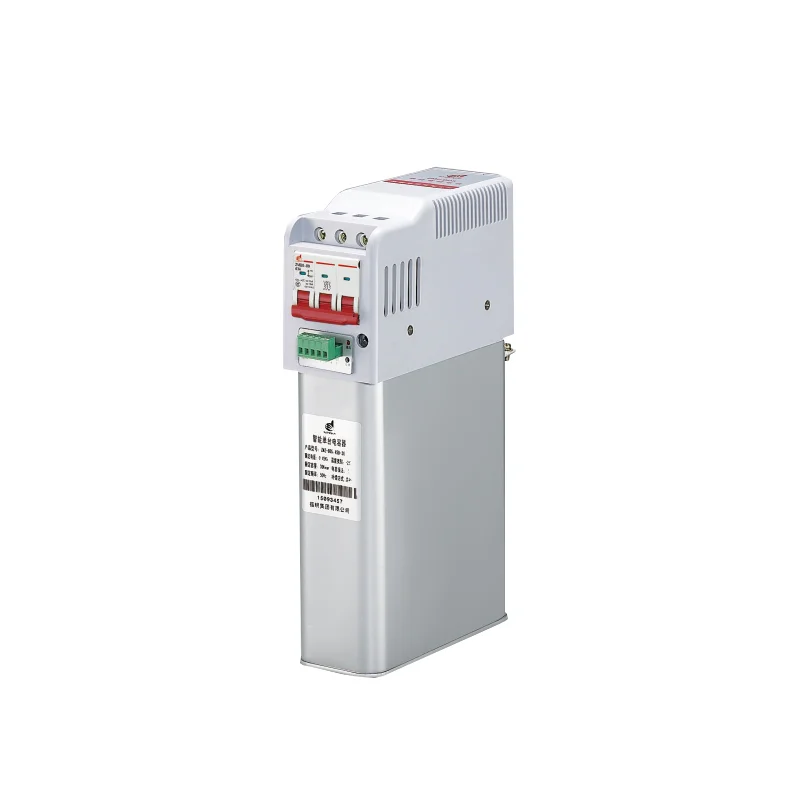
Table of Contents
The Role of a Power Capacitor in Voltage Smoothing
When electricity enters a power supply, it usually starts as Alternating Current (AC). This current swings back and forth, positive to negative, dozens of times a second. Electronics, however, generally need Direct Current (DC)—a steady, flat line of power. The first step in this transformation involves a rectifier, which flips the negative swings to positive. But even then, the power isn’t a straight line; it looks more like a series of bouncing hills. This is widely known as “ripple,” and sensitive chips absolutely hate it.
Imagine a water pipe that pulses with water every second rather than flowing smoothly. If you put a large tank in the middle of that line, the tank fills up during the pulses and drains slowly during the gaps. The output from the tank is a steady, continuous stream. A power capacitor works exactly the same way. It charges up to the peak voltage when the “hill” of electricity comes in, and then, as the voltage from the rectifier starts to drop, the capacitor discharges its stored energy to fill in the valley.
- The charging phase: The capacitor absorbs excess energy when the input voltage is high.
- The discharging phase: It releases energy when the input voltage drops.
- The result: A much smoother DC voltage with significantly less ripple.
From an engineering perspective, seeing this on an oscilloscope is quite satisfying. You go from a jagged, bumpy waveform to a nearly flat line just by adding the right capacitance to the circuit.
Managing Load Transients with a Power Capacitor
Voltage smoothing is only half the battle. The other major challenge in a power supply is that the device it is powering doesn’t always want the same amount of juice. Think about a gaming PC. One minute it is sitting idle on the desktop, and the next, the graphics card ramps up to 100% usage to render a complex scene. This creates a sudden, massive demand for current.
A power capacitor placed near the output acts like a localized energy reserve. because it stores energy in an electric field rather than chemically (like a battery), it can release that energy incredibly fast. When the load spikes, the capacitor dumps its stored charge instantly to support the voltage until the main power supply can catch up. It is this ability to handle “transients”—those rapid changes in current draw—that makes the capacitor indispensable for dynamic loads.
Different Types of Capacitors and Their Functions
| Capacitor Type | Primary Characteristic | Typical Role in Power Supply | Visual Identification |
|---|---|---|---|
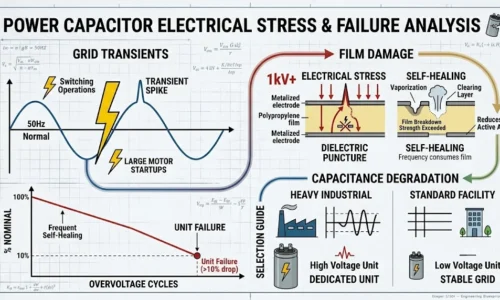
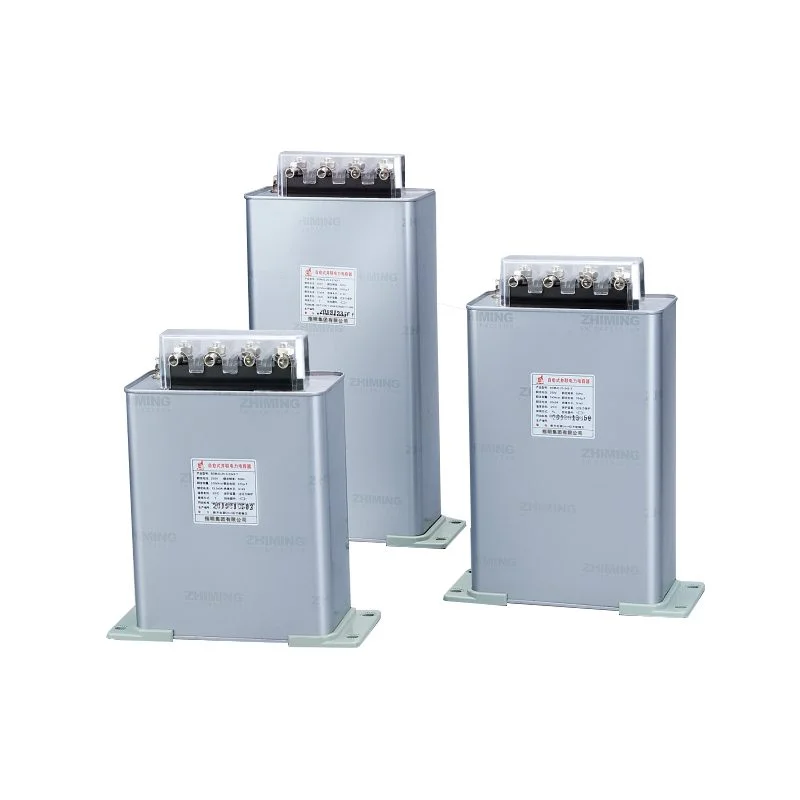
| High Voltage Power Capacitor | Extreme Voltage Tolerance | Situated on the “primary” side; it handles the raw rectified mains power and stabilizes the system against grid surges. | The physically largest cylinder on the board (often rated 400V+), or large metal/oil-filled boxes in industrial units. |
| Low Voltage Power Capacitor | High Capacitance Density | Located on the “secondary” side; provides the fine-tuned, smooth DC power required by chips, motors, or processors. | Clusters of smaller cylinders or solid polymer caps located near the output wire bundles. |
| Film Capacitor | High Stability | Safety capacitors (X and Y class) for filtering line noise and EMI (electromagnetic interference). | Boxy, often yellow or gray rectangular blocks found near the power cord inlet. |
Signs of a Failing Power Capacitor
One of the more unfortunate realities of electronics is that capacitors are often the first component to fail. Unlike a resistor or a transistor which might last effectively forever if not abused, electrolytic capacitors have a liquid electrolyte inside that can dry out or leak over time.
From a repair standpoint, identifying a bad power capacitor is often visual work. You look for the “bulge.” The top of these capacitors usually has a stamped “K” or “X” vent pattern. When the internal pressure gets too high due to heat or failure, the top puffs up like a domed roof. In worse cases, you might see a brownish, crusty substance leaking from the bottom.
When a capacitor starts to fail, it loses its ability to store charge. The result? The “ripple” comes back. The device might start behaving erratically—restarting randomly, freezing, or emitting a high-pitched whine. It feels almost like the device is getting “dirty” power, which, in essence, it is.
Safety Considerations in Maintenance
It is worth repeating a warning that every technician learns early on: a power capacitor can be dangerous even when the device is unplugged. Because their entire job is to store energy, large capacitors in high-voltage power supplies can hold a lethal charge for minutes, or sometimes even longer, after power is removed.
Most modern designs include “bleeder resistors” connected in parallel to slowly drain the charge when the unit is off, but these can fail too. It is a good habit to treat every large capacitor as if it is fully charged until proven otherwise.
Resources
- Wikipedia: Capacitor: This entry covers the fundamental physics of the electric field storage mechanism, the history of the Leyden jar, and the mathematical formulas defining capacitance. It serves as a solid baseline for understanding the theory.
- ScienceDirect: Ripple Voltage: This topic page aggregates academic abstracts and book chapters discussing the specific engineering challenge of ripple voltage in rectifier circuits. It offers a more rigorous look at why smoothing is necessary for sensitive electronics.
FAQ
Can I replace a power capacitor with one that has a higher voltage rating?
Generally, yes. The voltage rating on a capacitor is the maximum it can handle. Using a capacitor rated for 25V in a 16V circuit is perfectly fine and often offers a better safety margin. However, you should never use a lower voltage rating, as the capacitor could explode.
Does a bigger capacitor always mean better performance?
Not necessarily. While more capacitance can reduce ripple, installing a power capacitor that is too large can cause a massive inrush of current when the device is first turned on. This surge can blow fuses or damage the rectifier bridge before the capacitor even has a chance to charge.
Why do power supplies hum?
That hum is often called “coil whine,” but it can also be related to capacitors. As capacitors age and their internal resistance (ESR) rises, they struggle to smooth the voltage effectively. This can cause transformers and coils to vibrate physically at the frequency of the AC line (50Hz or 60Hz), creating an audible buzzing sound.