Table of Contents
Why Accurate Capacitor Bank Calculation Matters
Getting the sizing right for a capacitor bank isn’t something to guess at. Too small, and the investment barely makes a dent in power factor problems. Too large, and you risk overcorrection—which brings its own set of electrical headaches. Voltage spikes, equipment stress, and wasted capital are all possible outcomes of poor calculations.
The process involves some mathematics, yes, but nothing impossibly complex. With the right data and formulas, most engineers and facility managers can work through the calculations reasonably well. Though honestly, double-checking the numbers never hurts.
Understanding the Fundamentals Before Calculating
Before diving into formulas, grasping a few basic concepts helps tremendously.
Power factor represents the ratio between real power (kW) and apparent power (kVA). When inductive loads dominate a system—motors, transformers, certain lighting—the power factor drops below 1.0. This lagging condition means the facility draws more current than necessary for the actual work performed.
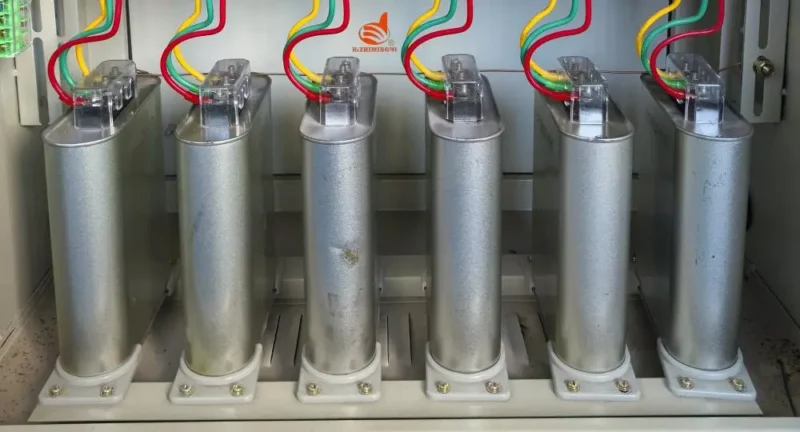
A capacitor bank introduces capacitive reactive power to offset inductive reactive power. The goal? Bringing power factor up to an acceptable level, typically 0.95 or higher depending on utility requirements.
Key Terms to Know
- Real Power (P)– measured in kilowatts (kW), the actual working power
- Reactive Power (Q)– measured in kilovolt-amperes reactive (kVAr), the non-working power
- Apparent Power (S)– measured in kilovolt-amperes (kVA), the total power drawn
- Power Factor (PF)– ratio of real power to apparent power
Using Multiplier Tables for Quick Calculations
Current PF | Target 0.90 | Target 0.95 | Target 0.98 | Target 1.00 |
0.65 | 0.74 | 0.84 | 0.93 | 1.17 |
0.70 | 0.59 | 0.69 | 0.78 | 1.02 |
0.75 | 0.47 | 0.55 | 0.65 | 0.88 |
0.80 | 0.35 | 0.42 | 0.52 | 0.75 |
0.85 | 0.25 | 0.32 | 0.42 | 0.65 |
0.90 | — | 0.14 | 0.28 | 0.48 |
These multiplier values come from standard electrical engineering references. Quite handy for quick estimates.
Practical Example Calculation
Consider a manufacturing facility with these parameters:
- Active power load: 500 kW
- Current power factor: 0.75
- Target power factor: 0.95
Using the multiplier table, the factor for improving from 0.75 to 0.95 is 0.55.
Required capacitor bank = 500 kW × 0.55 = 275 kVAr
So a capacitor bank rated around 275-300 kVAr would suit this application. Standard equipment sizes might lead to selecting a 300 kVAr unit or perhaps multiple smaller banks.

Factors That Affect Capacitor Bank Selection
Raw calculations provide starting points, but real-world considerations often modify final decisions.
Load Variability
Facilities with fluctuating loads present challenges. A factory running heavy machinery during day shifts but minimal equipment at night needs different treatment than one with constant 24/7 operations. Automatic capacitor banks with stepped switching often make more sense for variable conditions.
Harmonic Considerations
Modern facilities frequently contain harmonic-generating equipment:
- Variable frequency drives
- LED lighting with electronic ballasts
- Computer systems and servers
- Uninterruptible power supplies
Harmonics can interact badly with capacitor banks, sometimes causing resonance conditions. Detuned reactors or special harmonic-rated capacitors may be necessary. This factor alone can change sizing calculations significantly.
Future Load Growth
Smart planning accounts for expansion. Adding a 10-20% margin to calculated values helps accommodate future equipment additions without requiring immediate capacitor bank upgrades.
Common Calculation Mistakes
Several errors appear frequently in capacitor bank sizing:
- Using nameplate ratings instead of actual measured loads
- Ignoring power factor variations throughout operating cycles
- Forgetting to account for existing correction equipment
- Assuming all loads operate simultaneously at full capacity
- Neglecting ambient temperature effects on capacitor performance
Any of these can throw calculations off considerably. Measured data from power quality analyzers beats assumptions every time.
Verification After Installation
Even careful calculations deserve verification. After installing a capacitor bank, monitoring actual power factor improvements confirms whether sizing was appropriate. Most automatic systems include monitoring capabilities that track performance continuously.
If results fall short of expectations, additional capacitor stages might be needed. If overcorrection appears, reducing active stages or adjusting controller settings typically resolves the issue. If you want to know more about capacitor bank, please read What is a capacitor bank.
FAQ
What happens if a capacitor bank is oversized?
Oversized capacitor banks cause leading power factor, which can result in overvoltage conditions, increased losses, and potential penalties from some utilities. Equipment damage becomes possible in severe cases, and some utilities actually penalize leading power factor just like lagging.
Can the same capacitor bank work for different voltage systems?
No, capacitor banks are designed for specific voltage ratings. Installing a capacitor bank rated for different voltage than the system voltage causes improper operation—either insufficient correction or equipment damage. Always match voltage ratings precisely.
How often should capacitor bank calculations be reviewed?
Recalculating makes sense whenever significant load changes occur—new equipment installations, production line modifications, or facility expansions. Annual reviews during energy audits provide good opportunities to verify that existing capacitor banks still meet current requirements.