Modern electrical systems face a problem that barely existed decades ago. Variable frequency drives, LED lighting, computers, and countless other nonlinear loads generate harmonic currents that pollute power systems. Standard capacitor banks — designed for clean sinusoidal conditions — often suffer premature failure in these environments.
A detuned capacitor bank solves this problem through elegant engineering. By adding series reactors to capacitors, the combination avoids dangerous resonance conditions while still providing power factor correction. The approach has become standard practice in industrial and commercial installations where harmonic distortion is present.
Understanding what makes a detuned capacitor bank different — and when to specify one — prevents costly equipment failures and ensures reliable power factor correction.

Table of Contents
How a Detuned Capacitor Bank Works
The Resonance Problem Explained
Capacitors and system inductance form a natural resonant circuit. When harmonic frequencies align with this resonant frequency, current amplification occurs — sometimes dramatically. A fifth harmonic current that should measure a few amps might multiply to hundreds of amps through resonance.
The consequences include:
- Capacitor overheating and premature failure
- Fuse operations and nuisance tripping
- Voltage distortion affecting other equipment
- Audible noise from vibrating components
- Potential catastrophic capacitor rupture
Standard capacitor banks essentially gamble that resonance won’t occur at frequencies present in the system. In today’s harmonic-rich environments, this gamble frequently loses.
Detuning Reactor Function
A detuned capacitor bank adds series reactors — inductors wired in line with the capacitors. These reactors shift the natural resonant frequency below any significant harmonic frequencies present in the system.
The most common detuning factor is 7% (sometimes expressed as p=7% or 189 Hz tuning). This places resonance below the fifth harmonic (250 Hz), which is typically the lowest significant harmonic in most power systems. Other common detuning factors include 5.67% and 14%, chosen based on specific harmonic conditions.
Detuning Factor | Resonant Frequency | Protection Level |
5.67% (p=5.67) | 210 Hz | Below 5th harmonic |
7% (p=7) | 189 Hz | Well below 5th harmonic |
14% (p=14) | 134 Hz | Below 3rd harmonic |
Benefits and Limitations of Detuned Capacitor Bank Systems
Key Advantages
A detuned capacitor bank provides power factor correction safely in harmonic-polluted environments where standard capacitors would fail. Beyond mere survival, additional benefits emerge:
- Reduced harmonic voltage distortion through partial absorption
- Lower stress on upstream transformers and cables
- Improved power quality for sensitive equipment nearby
- Longer capacitor service life compared to unprotected installations
- Compliance with utility harmonic limits in some cases
The partial harmonic filtering effect — while not the primary purpose — provides meaningful benefit. Detuned systems absorb some harmonic current rather than amplifying it, improving overall power quality somewhat.
Design Considerations
Detuning reactors add cost, physical size, and some power losses compared to plain capacitor banks. The reactors themselves consume real power through resistance and core losses. Heat generated requires adequate ventilation.
Voltage rise across capacitors in a detuned capacitor bank also needs attention. The series reactor drops voltage, meaning capacitors see higher voltage than the supply to deliver rated reactive power. Capacitors must be rated accordingly — typically 110% or higher of nominal system voltage.
These considerations don’t diminish the value of detuning. They simply require proper engineering rather than treating a detuned capacitor bank as a direct substitute for standard equipment.
Leading Detuned Capacitor Bank Manufacturers
Zhiming Global
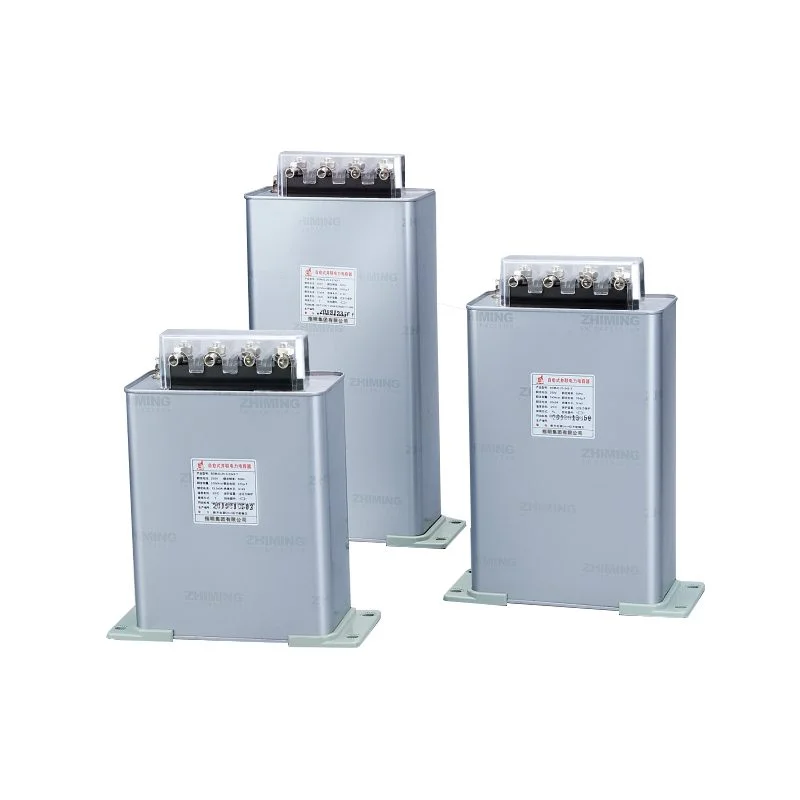
Zhiming Global produces detuned capacitor bank systems designed for industrial and commercial power factor correction applications. Their product range covers various voltage levels and reactive power ratings suitable for different facility sizes.
The company emphasizes:
- Complete integrated systems with matched components
- Customization for specific harmonic environments
- Robust construction for demanding industrial conditions
- Competitive pricing for quality equipment
- Technical support for proper application engineering
For buyers seeking detuned solutions with responsive manufacturer support, Zhiming Global represents a capable option worth evaluating alongside established brands.
Epcos
Epcos — now part of TDK Corporation — has long been recognized in power quality equipment including detuned capacitor bank products. Their PhaseCap and PQS series include detuned configurations widely specified in European and global markets.
German engineering heritage shows in product documentation and application guidelines. Epcos products appear frequently in specifications requiring premium-quality components. If you want to know more about capacitor bank, please read What is a capacitor bank.
FAQ
When is a detuned capacitor bank necessary instead of standard capacitors?
A detuned capacitor bank becomes necessary when harmonic distortion levels create resonance risk with standard capacitors. Generally, if total harmonic distortion exceeds 5% or if significant fifth harmonic current exists, detuning should be considered. Facilities with large variable frequency drive populations, extensive LED or fluorescent lighting, data centers, or welding equipment typically require detuned solutions. Some consulting engineers specify detuned systems as standard practice regardless of measured harmonics — reasoning that harmonic conditions change over time as equipment is added or modified.
Can a detuned capacitor bank replace harmonic filters?
A detuned capacitor bank and harmonic filters serve different primary purposes, though overlap exists. Detuned systems primarily provide power factor correction while avoiding resonance problems — they absorb some harmonics incidentally but don’t target specific harmonic reduction. True harmonic filters are tuned precisely to problematic frequencies to actively remove harmonic currents from the system. When specifications require meeting strict harmonic limits, dedicated harmonic filters or active filtering solutions typically prove necessary. A detuned capacitor bank alone may not achieve sufficient harmonic reduction.
How does detuning factor selection affect performance?
Detuning factor selection determines where the resonant frequency falls relative to system harmonics. Standard 7% detuning places resonance at 189 Hz — safely below the fifth harmonic at 250 Hz. This works for most commercial and industrial applications where fifth harmonic dominates. However, facilities with significant third harmonic content — common with single-phase nonlinear loads — may need 14% detuning placing resonance at 134 Hz, below the third harmonic. Selecting insufficient detuning leaves resonance risk with lower-order harmonics. Excessive detuning increases reactor size, cost, and losses without benefit.