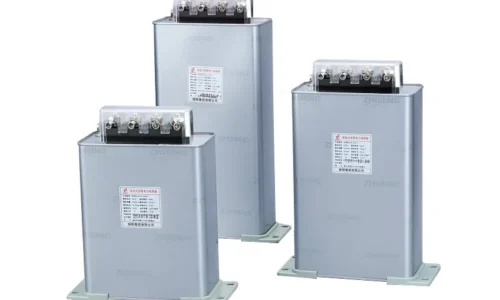
This question comes up surprisingly often — and the answer isn’t quite as simple as picking one or the other. A capacitor bank can operate in both AC and DC systems. The distinction lies not in the capacitor itself but in how it’s designed, constructed, and applied for each type of service.
Capacitors fundamentally store and release electrical energy. They do this regardless of whether the voltage across them alternates or stays constant. But the demands placed on a capacitor bank differ dramatically between AC and DC applications, and using the wrong type in the wrong system leads to problems. Sometimes serious ones.
Understanding the differences matters for anyone specifying, installing, or maintaining these systems.
Table of Contents
How a Capacitor Bank Functions in AC Systems
The AC Application
Most people encounter capacitor bank installations in AC power systems. This is where power factor correction happens — the most common reason for installing capacitor banks in industrial and commercial settings.
In an AC system, the capacitor bank continuously charges and discharges as voltage alternates. Sixty times per second on a 60Hz system. The capacitor doesn’t just sit there holding energy — it’s constantly cycling, absorbing and releasing reactive power every half cycle.
This continuous cycling creates specific stresses:
- Dielectric heating from alternating electric field
- Internal losses generating heat proportional to frequency
- Voltage reversals stressing insulation repeatedly
- Current flow even at steady-state operation
AC-rated capacitor banks are designed specifically for this punishing duty cycle. The dielectric materials, internal connections, and thermal management all account for continuous cycling operation. They’re built to handle the heat and stress that comes with constant charge-discharge behavior.
Common AC Capacitor Bank Applications
AC capacitor bank installations show up across many settings:
- Utility substation power factor correction
- Industrial motor compensation
- Harmonic filtering systems
- Series compensation on transmission lines
- Static VAR compensators for voltage support
Each application exploits the capacitor bank’s ability to generate or absorb reactive power in AC circuits — something that only makes sense in alternating current systems where reactive power flow exists.
How a Capacitor Bank Works in DC Systems
The DC Application
DC capacitor bank applications—including those for high voltage capacitor bank systems—look quite different from their AC counterparts. In a DC system, the capacitor charges up and then ideally holds that charge. No continuous cycling. No reactive power exchange.
Instead, DC high voltage capacitor bank systems serve primarily as energy storage devices. They charge slowly from a DC source and either maintain voltage stability or discharge their stored energy when needed, often in a single, controlled pulse.
The stress profile differs significantly from AC service. Voltage doesn’t reverse. The dielectric experiences constant unidirectional stress rather than alternating fields. There’s minimal internal heating during steady-state operation, though high-current discharge events can generate substantial transient currents.
DC high voltage capacitor bank applications include:
Power supply filtering and smoothing
Energy storage for pulsed power systems
DC bus stabilization in drives and inverters
Welding equipment energy storage
Backup power for brief interruptions
Design Differences Between AC and DC Capacitor Banks
Characteristic | AC Capacitor Bank | DC Capacitor Bank |
Voltage stress | Alternating, cycling | Constant, unidirectional |
Internal heating | Continuous, significant | Minimal during hold |
Dielectric design | Low-loss, heat-tolerant | High field strength focus |
Discharge pattern | Continuous cycling | Occasional or pulsed |
Polarity sensitivity | Non-polarized required | Polarized types possible |
Typical lifespan factor | Cycling fatigue | Voltage endurance |
Using an AC-rated capacitor bank on DC service might seem safe since DC is less demanding in some respects. But DC voltage can cause electrochemical effects in certain dielectric systems that AC voltage doesn’t produce. Conversely — and this is the more dangerous mistake — applying a DC-rated capacitor bank in AC service often leads to rapid overheating and failure because the design can’t handle continuous cycling losses.
Choosing the Right Capacitor Bank for Your System
AC or DC — Getting the Selection Right
The selection process starts with identifying the system type and application requirements. It sounds obvious, but misapplication happens more than it probably should.
For AC systems, key specifications include:
- System voltage and frequency
- Required reactive power rating (kVAR)
- Harmonic environment assessment
- Switching duty requirements
- Ambient temperature conditions
For DC systems, different parameters matter:
- Operating voltage and maximum surge voltage
- Energy storage requirements (joules)
- Charge-discharge cycle frequency
- Peak discharge current capability
- Capacitance stability over time
Some modern applications blur the line between AC and DC. Variable frequency drives, for instance, contain both AC and DC sections with different capacitor bank requirements in each stage. Renewable energy inverters similarly require DC bus capacitors on one side and sometimes AC filter capacitors on the other.
Voltage Ratings and Safety Margins
One critical consideration — voltage ratings for AC and DC aren’t directly comparable. An AC voltage rating refers to RMS (root mean square) value, while peak voltage is actually 41% higher. A capacitor bank rated for 480V AC experiences peak voltages around 679V.
This means a capacitor rated only for 480V DC cannot safely operate at 480V AC despite the numbers appearing identical. The peak voltage would exceed its rating every half cycle. Understanding this relationship prevents dangerous misapplication.
FAQ
Can an AC capacitor bank be used in a DC circuit?
Generally, AC-rated capacitor banks can operate in DC circuits since they’re designed for more demanding conditions — continuous cycling, voltage reversals, and sustained internal heating. However, this doesn’t mean it’s always optimal. AC capacitors may be oversized or overpriced for straightforward DC applications. Additionally, some AC capacitor bank designs use internal series connections and voltage grading schemes unnecessary for DC service, adding cost without benefit. While the practice is technically safe in most cases, selecting capacitors specifically rated and designed for DC applications typically provides better performance and value for DC-specific requirements.
Why can't DC capacitors work in AC systems?
DC-rated capacitors often use construction methods that cannot handle continuous AC cycling. Polarized electrolytic types fail destructively with voltage reversal. Even non-polarized DC capacitors may lack the low-loss dielectric characteristics needed for continuous AC operation. The internal heating from AC cycling exceeds what DC-oriented designs can dissipate safely. Using a DC capacitor bank in AC service risks overheating, dielectric breakdown, and potentially catastrophic failure including fire or explosion. This isn’t a gray area — putting DC-rated capacitors on AC systems is genuinely dangerous and violates basic electrical engineering practice.
What type of capacitor bank do variable frequency drives use?
Variable frequency drives typically use DC bus capacitor banks — usually aluminum electrolytic or film types — between the rectifier input stage and the inverter output stage. These capacitors smooth the rectified DC voltage and provide energy buffering for the inverter. They operate in DC service despite the drive being connected to an AC power system. The capacitor bank sees DC voltage with ripple rather than full AC cycling. Some drives also incorporate AC filter capacitors on the input or output side for harmonic mitigation, which require proper AC ratings. The DC bus capacitor bank represents one of the most life-limiting components in drive systems and typically requires replacement after 7-15 years depending on operating temperatures and loading.