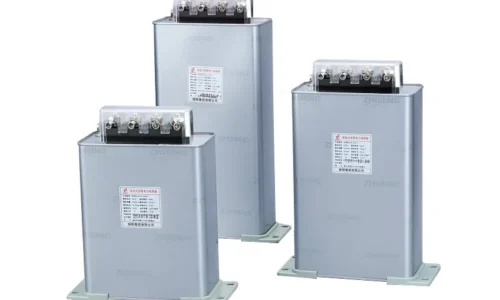
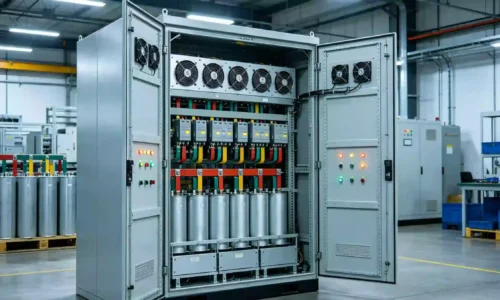
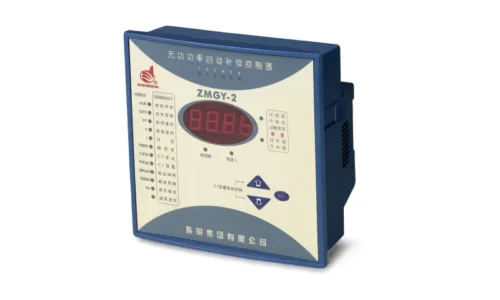
The question comes up more often than you might expect. Capacitors store energy. Batteries store energy. Both can release that energy when needed. So why not use a power capacitor as a power source instead of batteries?
The short answer is yes — but with significant limitations that make capacitors impractical for most applications where batteries currently dominate. The longer answer involves understanding what capacitors actually do well, where they fall short, and the specific niches where capacitor-based power sources genuinely make sense.
It’s one of those topics where the theoretical possibility and the practical reality diverge considerably. A power capacitor absolutely can release stored energy to power a load. Whether it can do so usefully depends entirely on the application requirements.
Table of Contents
How a Power Capacitor Stores Energy
Basic Energy Storage Mechanism
Capacitors store energy in an electric field between two conductive plates separated by an insulating dielectric. Charging a capacitor moves electrons from one plate to another, creating a voltage difference. That stored charge represents potential energy ready for release.
The amount of energy stored follows a simple relationship:
Energy (Joules) = ½ × Capacitance × Voltage²
This formula reveals something important. Energy scales with the square of voltage, so higher voltage capacitors store dramatically more energy for the same capacitance. But capacitance values achievable in practical power capacitor designs remain relatively modest compared to battery energy density.
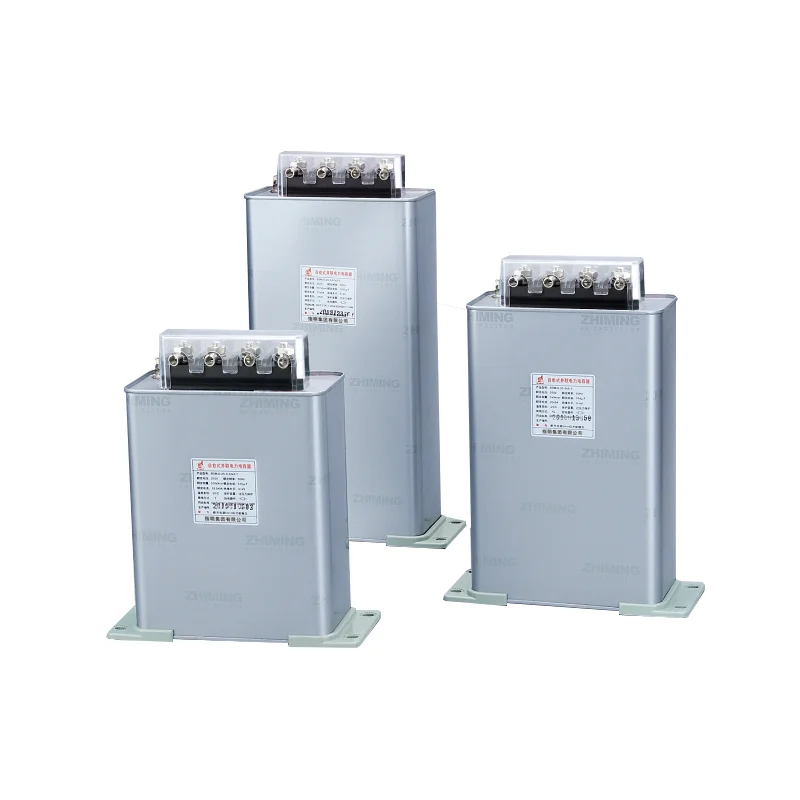
Comparing Energy Density to Batteries
Here’s where the limitations become stark. A typical lithium-ion battery stores around 150-250 Wh/kg. A conventional power capacitor might manage 0.01-0.1 Wh/kg. That’s roughly a thousand-fold difference — not a gap that clever engineering easily closes.
Even supercapacitors, which represent the high end of capacitor energy storage, reach only about 5-10 Wh/kg. Better than conventional capacitors by a wide margin, but still far below battery territory.
Energy Storage Device | Typical Energy Density (Wh/kg) | Power Density (W/kg) | Cycle Life |
Conventional Capacitor | 0.01 – 0.1 | 10,000+ | Millions+ |
Supercapacitor | 5 – 10 | 1,000 – 10,000 | 100,000 – 1,000,000 |
Lead-Acid Battery | 30 – 50 | 100 – 200 | 500 – 1,000 |
Lithium-Ion Battery | 150 – 250 | 250 – 500 | 500 – 2,000 |
When a Power Capacitor Works as a Power Source
Short-Duration, High-Power Applications
Where capacitors genuinely shine as power sources involves brief bursts of high power. The application needs energy fast, but doesn’t need it for long.
Examples include:
- Camera flash units that discharge stored energy in milliseconds
- Defibrillators requiring rapid high-energy pulses
- Electromagnetic launchers and coilguns
- Spot welding equipment needing intense momentary current
- Engine starting systems for large vehicles
In these cases, a power capacitor delivers exactly what’s needed. Batteries capable of equivalent instantaneous power would require massive oversizing, suffer rapid degradation from pulse discharge stress, or simply couldn’t respond fast enough.
Backup Power for Brief Interruptions
Power capacitors increasingly appear in ride-through applications — maintaining power during momentary supply interruptions measured in seconds rather than minutes. Uninterruptible power supplies for data centers sometimes use supercapacitor banks to cover the gap while diesel generators start.
The economics work when:
- Required backup duration is very short (seconds to perhaps a minute)
- Cycle life matters (capacitors handle hundreds of thousands of charge-discharge cycles)
- Maintenance-free operation is valuable (no battery replacement schedules)
- Temperature extremes exist (capacitors tolerate wider temperature ranges than many battery chemistries)
Limitations of Using a Power Capacitor as Primary Power
Energy Capacity Constraints
For anything requiring sustained power delivery — running a laptop for hours, powering a home during an outage, operating an electric vehicle across meaningful distances — power capacitors simply cannot store enough energy in reasonable size and weight.
The energy density gap is fundamental to physics and materials science, not an engineering problem awaiting a clever solution. Improvements continue, but capacitors are unlikely to match battery energy density within any foreseeable timeframe.
Voltage Decay During Discharge
Unlike batteries that maintain relatively constant voltage until nearly depleted, capacitor voltage drops linearly as charge flows out. A capacitor charged to 5V might deliver useful power down to perhaps 2.5V before the voltage falls too low for the application.
This means:
- Only about 75% of stored energy is practically usable
- Power electronics must handle wide input voltage range
- Efficiency losses increase as voltage drops
DC-DC converters can compensate, but they add complexity, cost, and their own efficiency losses. Batteries maintain voltage more gracefully throughout discharge.
Supercapacitors as a Power Capacitor Compromise
Bridging the Gap
Supercapacitors (also called ultracapacitors or electrochemical double-layer capacitors) occupy interesting middle ground. They store vastly more energy than conventional capacitors while retaining much of the power delivery and cycle life advantages.
Key supercapacitor characteristics:
- Energy density 100-500 times conventional capacitors
- Power density still 10-100 times better than batteries
- Cycle life in the hundreds of thousands
- Fast charge acceptance — minutes rather than hours
- Wide operating temperature range
- No memory effect or complex charge management
For applications matching these strengths, supercapacitors genuinely function as practical power sources. Electric buses that charge briefly at each stop, grid stabilization systems, heavy equipment with frequent start-stop cycles — these represent real-world supercapacitor power source implementations.
Hybrid Energy Storage
Increasingly, sophisticated power systems combine supercapacitors with batteries. The battery handles sustained energy needs. The power capacitor manages transients, absorbs regenerative energy, and reduces stress on the battery.
This hybrid approach often outperforms either technology alone:
- Battery life extends because capacitors handle high-power events
- Overall system size and weight can actually decrease
- Response to load transients improves
- System efficiency increases under variable load profiles
If you want to know more about power capacitor, please read What Does A Power Capacitor Do In A Power Supply.
FAQ
How long can a power capacitor supply power to a device?
Duration depends entirely on stored energy and load power. A small supercapacitor might power an LED for minutes. A large capacitor bank might run industrial equipment for seconds during a power dip. The calculation is straightforward: time equals stored energy divided by power consumption. Practically, most power capacitor applications measure useful runtime in seconds to perhaps a few minutes — not hours. For anything requiring sustained power over longer periods, batteries remain the appropriate choice.
Can supercapacitors replace batteries entirely?
Not for most applications currently. Energy density remains the limiting factor. A supercapacitor bank storing equivalent energy to a smartphone battery would be far larger and heavier than acceptable. However, supercapacitors are replacing batteries in specific niches — backup power for brief outages, start-stop vehicle systems, regenerative energy capture, and applications where extreme cycle life matters more than energy capacity. The technologies are more complementary than competitive.
What happens if a power capacitor is overcharged?
Exceeding voltage ratings on a power capacitor leads to dielectric breakdown — the insulating layer between plates fails, allowing current to flow directly through. Results range from gradual degradation to immediate catastrophic failure including venting, rupture, or fire depending on capacitor type and energy involved. Electrolytic capacitors may vent electrolyte. Film capacitors may short permanently.