Table of Contents
The Vague Question of Capacitor Banks and Their Real-World Cost
The sticker shock is a familiar feeling for many facility managers. A monthly utility bill arrives, and buried near the bottom is an eye-watering penalty fee labeled “Power Factor Adjustment” or something equally vague. It is a frustrating expense because it feels like a penalty for simply using the electricity needed to run the business. The immediate solution that often comes up is installing capacitor banks to correct the problem. But that naturally leads to the next big, and equally vague, question: what is the actual cost?
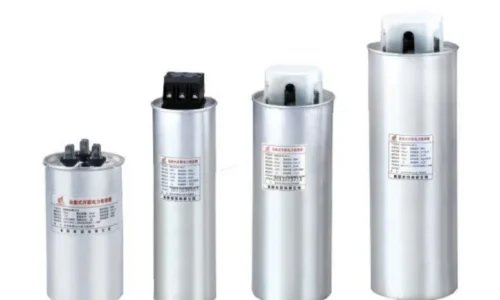
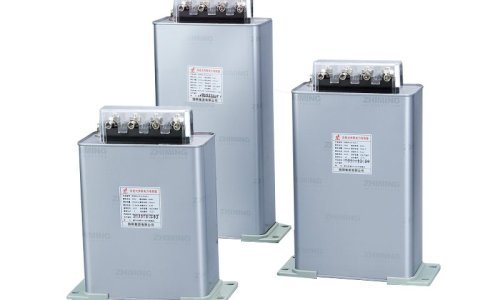
To be honest, asking for the cost of capacitor banks is a bit like asking for the cost of a vehicle. A simple utility truck is one price, while a complex piece of heavy construction machinery is another entirely. The price tag on the equipment itself can range from a few hundred dollars for a tiny, single-motor unit to tens of thousands of dollars for a large, intelligent system designed to manage an entire factory floor. The final number depends entirely on the specific electrical problems being solved.
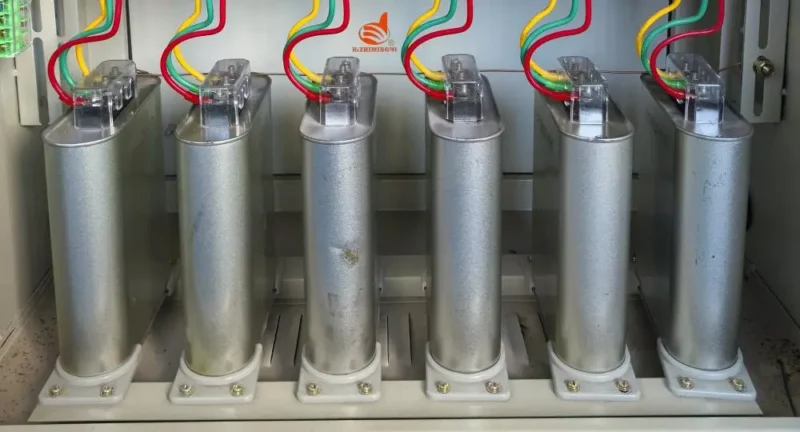
Key Factors That Drive the Cost of Capacitor Banks
The price of the hardware is not just pulled out of thin air. It is a direct reflection of the electrical work the unit is expected to perform. Several key technical specifications have a massive impact on the final quote one might receive from an electrical supplier.
When trying to budget for a project, these are the factors that really move the needle on cost:
Capacity (kVAR): This is the single biggest driver of cost. A small 5 kVAR unit for a single air compressor will be vastly cheaper than a massive 600 kVAR system needed for a large industrial plant.
Voltage Rating: Equipment designed for a standard 480-volt system is common and relatively inexpensive. Capacitor banks built to handle medium-voltage applications (like 4160V or higher) are a whole different class of equipment with a much higher price.
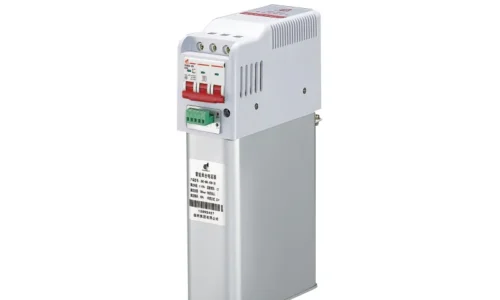
Fixed vs. Automatic: A simple, fixed unit that is always “on” is the cheapest option. An automatic system with a smart controller that switches capacitor stages on and off is significantly more complex and, therefore, more expensive.
Harmonic Filtering: If a facility is full of modern variable frequency drives (VFDs), the electrical system is likely polluted with harmonic noise. Special “detuned” capacitor banks with reactors are required to survive in this environment, and they carry a premium price.
Enclosure and Brand: A standard indoor enclosure is much cheaper than a rugged, weatherproof NEMA 3R enclosure for outdoor installation. And, of course, a well-known, reputable brand will generally cost more than a generic alternative.
A General Look at the Tiers of Capacitor Banks
To make sense of the pricing, it helps to break the equipment down into a few general categories. Most industrial applications will fall into one of these three tiers, each with a very different cost structure and purpose.
Equipment Tier | Typical Cost Range (Hardware Only) | Best Suited For | Key Feature |
Simple Fixed Unit | 200−200− 1,500 | A single, large motor that runs continuously with a constant load. | Very basic, low cost, and easy to wire. |
Automatic System | 2,000−2,000− 15,000+ | Most manufacturing plants with multiple machines turning on and off all day. | Intelligent controller prevents overcorrection. |
Detuned/Filter Bank | 5,000−5,000− 30,000+ | Facilities with heavy VFD or robotic welder usage creating “dirty” power. | Internal reactors protect the unit from harmonic damage. |
Don’t Forget the “Hidden” Costs Beyond the Capacitor Banks Themselves
The price tag on the unit itself is really just the beginning of the story. A successful power factor correction project involves much more than just buying a box of equipment. The total installed cost is what really matters.
One should always budget for the complete project, which almost always follows a predictable sequence:
The Power Quality Study: Before buying anything, an engineer needs to analyze the facility’s load. This professional study might cost anywhere from 1,000→1,000→5,000, but it is critical for sizing the system correctly.
Professional Installation: The labor cost for a qualified electrician to safely mount the unit, run conduit, and pull the necessary wiring can easily match, or even exceed, the cost of the hardware itself.
Circuit Protection: All capacitor banks need their own dedicated circuit breaker or fused disconnect switch. This is a required safety component that adds to the material cost.
Commissioning: Once installed, the system needs to be properly tested and calibrated. For automatic systems, this involves setting up the controller to react correctly to the building’s specific load profile.
If you want to know more about capacitor bank, please read What is a capacitor bank.
FAQ
Can one install capacitor banks themselves to save on labor costs?
This is strongly discouraged unless one is a licensed and experienced industrial electrician. Working with high-energy electrical equipment is incredibly dangerous. An improper installation can not only damage the new equipment but also pose a serious safety risk and potentially cause even bigger problems for the facility’s electrical system.
What is the typical return on investment (ROI) for this kind of project?
The ROI is usually surprisingly fast. For facilities that are being hit with heavy monthly penalty fees, it is very common for the entire project (including installation) to pay for itself in energy savings within 12 to 36 months. After that, the savings go directly to the bottom line.
Are capacitor banks worth the cost for a small machine shop?
It completely depends on how the local utility company structures its billing. If the utility doesn’t penalize commercial customers for a low power factor, then the investment is probably not worth it. However, if even a small shop is seeing a consistent penalty of a hundred dollars or more each month, then a small, appropriately sized system could easily pay for itself in a couple of years.