A modest investment in better capacitors, a snubber circuit, or a simple venting strategy can remove most of the common failure paths. But before you get to the fixing stage, you have to get the selection stage right.
It seems like every time a power supply or a motor drive goes down, the finger points at the capacitor bank. It’s the workhorse of the circuit, storing energy and smoothing out ripples, yet it often gets treated as an afterthought in the Bill of Materials. Picking the right power capacitor is about more than just looking at capacitance and voltage ratings on a datasheet; it is about understanding the environment where that component lives.
Table of Contents
Understanding the Application Environment
Before diving into specifications, consider the physical environment. Is the unit sitting in an air-conditioned server room, or baking inside a metal enclosure on a rooftop somewhere? Temperature kills capacitors faster than almost anything else.
When a power capacitor heats up beyond its dissipation capacity, degradation accelerates. Heat breaks down the dielectric, which increases leakage current, which generates more heat—a vicious cycle. In compact assemblies with poor ventilation, this escalation happens surprisingly fast. The ambient temperature inside an enclosure often runs significantly higher than the surrounding room temperature, something designers occasionally overlook.
Key questions worth asking:
- What’s the worst-case ambient temperature in that location?
- Is there actual airflow, or does the air sit stagnant?
- Are heat-generating components nearby—transformers, resistors, power supplies—radiating thermal energy toward the capacitor?
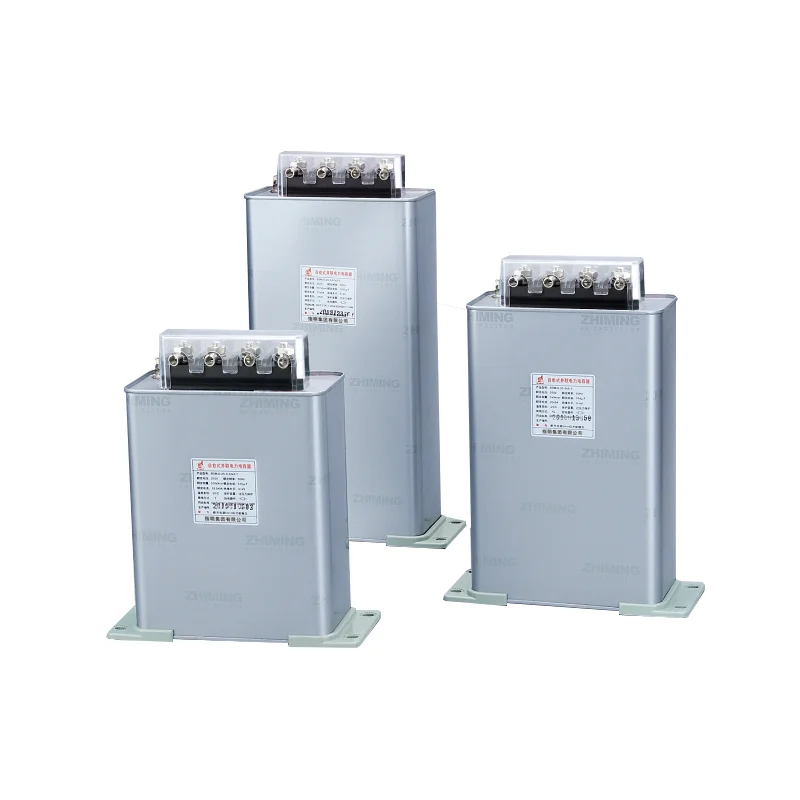
Voltage Ratings and Safety Margins for the Power Capacitor
A common rookie mistake is picking a capacitor rated exactly for the operating voltage. If your rail is 400V, a 400V capacitor is living on the edge. It might work on the bench, but out in the field, grid fluctuations and switching transients happen.
Field experience suggests that a healthy safety margin is non-negotiable. For a typical high power capacitor, you generally want a voltage rating at least 20% to 30% higher than your maximum steady-state voltage. If you are dealing with a high voltage capacitor, the stakes are even higher because the energy release during a failure is much more violent.
It is also worth noting that “surge” events aren’t rare. They are inevitable. If the budget allows, looking for self-healing properties in film capacitors can save a lot of headaches later. These high power capacitor types can recover from small internal shorts caused by transient spikes, whereas others might just fail catastrophically.
Handling Ripple Current and ESR
This is where things get technical, but it’s crucial. Every capacitor has internal resistance, known as Equivalent Series Resistance (ESR). When AC current (ripple) flows through the capacitor, that resistance generates heat inside the component.
If you pick a generic power capacitor with high ESR for a high-frequency switching application, it’s going to cook itself from the inside out. It doesn’t matter how cool the room is; the heat is coming from within. You need to check the datasheet for the “Rated Ripple Current” and ensure your circuit doesn’t exceed it. In fact, you should probably stay well below it.
Low ESR options are generally more expensive, but they run cooler. It is a trade-off. You pay a bit more now, or you pay for a warranty claim later.
Physical Constraints and Mounting
Sometimes the electrical specs are perfect, but the mechanical design is a disaster. As mentioned earlier, enclosures are sometimes too tight. If you jam a power capacitor into a corner with zero clearance, you are effectively insulating it.
Venting is another thing. Electrolytic capacitors have vents to release pressure if they fail. If you mount the capacitor so the vent is blocked by a PCB or the chassis wall, you have turned a safety feature into a potential bomb. It sounds dramatic, but it happens.
Also, consider vibration. Heavy capacitors on a vibrating machine (like a pump or compressor) need to be strapped down or glued. Solder legs alone aren’t enough to hold the weight of a large can. Eventually, the leads fatigue and snap.
Common Pitfalls in Selection
It’s easy to get tunnel vision on the price tag. However, experience shows that the “cheapest” option usually has the hidden cost of reliability issues.