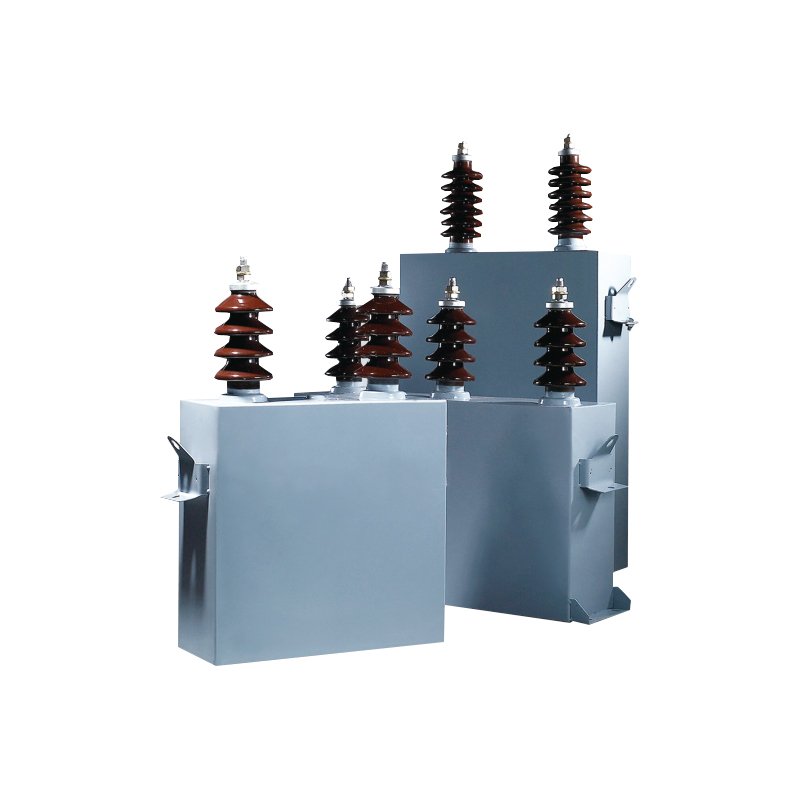
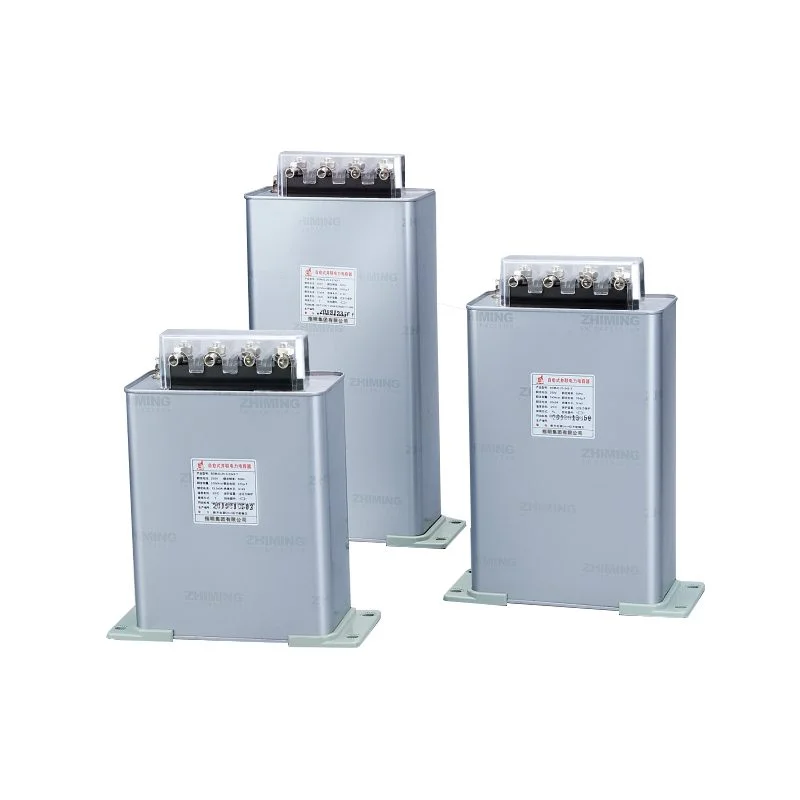
Grupa Zhiming koncentruje się na komponentach wysokiego i niskiego napięcia oraz kompletnych zestawach urządzeń. Punktem wyjścia są potrzeby klienta, a my projektujemy i dostosowujemy produkcję, aby zapewnić, że każdy element wyposażenia jest zbudowany tak, aby spełnić jego potrzeby w zakresie zasilania.
Maksymalizacja wydajności i współczynnika mocy
A high voltage single phase power capacitor is a passive reactive power component designed to operate on single phase alternating current systems with nominal voltages typically above 1 kV AC, often ranging from 3 kV up to 35 kV. Unlike low voltage capacitors that serve industrial distribution panels, this device is used in medium voltage or high voltage networks — such as substations, utility feeders, or large industrial plants with dedicated step‑up transformers. The construction uses a metallized polypropylene film or a combination of paper and film, impregnated with a biodegradable dielectric fluid. A single phase design means the capacitor has two terminals (line and neutral) and is intended for connection between a phase conductor and earth (or between two phases in some configurations). You often find high voltage single phase power capacitors assembled into banks to form three phase correction groups, or used individually for single phase loads like railway traction systems or arc furnaces.
| Funkcja | Opis | Typowe dane / zakres |
|---|---|---|
| Korekcja współczynnika mocy | Provides leading reactive current to offset inductive loads on a single phase high voltage line | PF improvement from 0.7 lagging to 0.95 or higher |
| Voltage Support | Boosts local voltage by reducing the reactive component of line current | Voltage rise: 1% to 5% per bank, depending on network impedance |
| Reduction of Transmission Losses | Lowers I²R losses in cables and transformers by reducing reactive current flow upstream | Loss reduction typically 10% – 30% for a well‑corrected feeder |
| Harmonic Filtering (detuned version) | When combined with a series reactor, blocks or absorbs specific harmonic orders (5th, 7th, etc.) | Tuning frequency: 189 Hz or 135 Hz (for 50 Hz systems) |
| Individual Phase Balancing | In a three phase system with unbalanced loads, single phase capacitors can be switched independently on each phase | Each phase corrected separately to avoid over‑compensation on light phases |
| Reactive Energy Metering Support | Works with utility meters to reduce kvarh penalties, especially on long rural feeders | Typical payback period: 12 to 24 months |
This table helps engineers and procurement teams quickly match the right HV single phase power capacitor to their system requirements.
| Parametr | Typowa wartość / zakres | Uwagi |
|---|---|---|
| Rated Voltage (Un) | 3 kV, 6 kV, 10 kV, 11 kV, 15 kV, 20 kV, 33 kV, 35 kV | Single phase, 50 Hz or 60 Hz |
| Rated Output (kvar) | 50 kvar to 500 kvar per unit | Larger units built as multiple elements in one tank |
| Capacitance Tolerance | –5% to +10% (standard) / –0% to +5% (premium) | Measured at 25°C |
| Dielectric System | Metallized polypropylene film with biodegradable oil (e.g. RAPO, BEHP) | Dry type or semi‑dry available |
| Losses (Dielectric + Resistive) | ≤ 0.2 W/kvar (for film type) / ≤ 0.5 W/kvar (paper‑film) | At rated temperature |
| Rezystor rozładowania | Built‑in, discharges to ≤ 50 V within 5 minutes (or 1 minute for some standards) | Safety for maintenance |
| Overpressure Protection | Internal isolating device (fuse or disconnector) that activates when internal pressure rises due to fault | Removes capacitor from circuit |
| Temperature Category | –40°C to +55°C (outdoor) / –25°C to +50°C (indoor) | Derating above 50°C |
| Insulation Level (BIL) | 75 kV to 150 kV (depends on rated voltage) | Basic Lightning Impulse level |
| Terminals | Porcelain or composite bushing, one for line, one for ground/neutral | Creepage distance per pollution level |
| Standard Compliance | IEC 60871‑1, IEEE 18, GB/T 11024 | Check local grid requirement |
Where Our High Voltage Single Phase Power Capacitor Delivers Proven Results
A high voltage single phase power capacitor is not a component you simply add to any panel without analysis. Below are specific high voltage network situations where our single phase capacitor reduces utility demand charges caused by low power factor on long rural feeders, improves voltage regulation at the end of a 10 kV or 20 kV line, and prevents harmonic resonance that sometimes appears when switching large capacitor banks on weak grids.
On a three phase system with unbalanced loading — for example a welding shop with heavy single phase loads, or a railway traction network — using three phase capacitors forces the same correction on all legs, possibly over‑correcting the light phase and under‑correcting the heavy one.
High voltage capacitors usually run continuously, so even small internal losses add up to significant wasted energy over a year. Our high voltage single phase power capacitor uses a metallized polypropylene film with a low loss impregnating oil.
When a capacitor element fails due to voltage spikes or end‑of‑life, internal gas pressure builds up quickly. If not safely vented or isolated, the tank can rupture. ZHIMING’s design includes a folded metal bellows that operates a mechanical disconnect when internal pressure exceeds a safe limit.
Grid operators often upgrade from 10 kV to 20 kV, or from 11 kV to 33 kV. Replacing all capacitor racks can be expensive. ZHIMING offers high voltage single phase power capacitors in a family of voltage ratings that share similar mounting dimensions and bushing spacing.
Most high voltage capacitors are installed outdoors on concrete pads or steel structures, exposed to sun, rain, salt fog, and temperature shifts. Our units use all‑welded stainless steel or powder‑coated steel cases, with porcelain bushings having a creepage distance suitable for high pollution areas (class IV).
A capacitor that meets only one standard creates problems when a project requires the other. ZHIMING’s high voltage single phase power capacitor is designed to satisfy both IEC 60871‑1 and IEEE 18 requirements (with some labeling adjustments).
Wiodący producent kondensatorów mocy z ponad 25-letnim doświadczeniem jest tutaj, aby odpowiedzieć na wszystkie pytania - obejmujące wszelkie kwestie związane z produktem, pytania biznesowe lub wątpliwości związane z usługami.
Wciąż masz pytania? Jesteśmy tutaj, aby pomóc
Nie znalazłeś tego, czego szukałeś?
Skontaktuj się z nami w każdej chwili
No. Connecting any capacitor directly to a live high voltage line without a dedicated switching device (vacuum contactor or circuit breaker) is dangerous and usually prohibited by grid codes. You need an appropriate switch or contactor with making capacity for inrush current. The capacitor alone is not a switching device.
You first measure the existing power factor on that phase, then calculate the required reactive power using: Qc = P × (tan φ1 – tan φ2), where P is the active load on that phase. For a rough estimate: on a 20 kV line, each 100 kvar increases voltage by roughly 1% to 2% depending on line inductance. ZHIMING provides a free calculation sheet with any inquiry.
The capacitive reactance decreases (Xc = 1/(2πfC)). At 60 Hz, the capacitor draws 20% more current than at 50 Hz for the same voltage. That may overload the internal elements and the fuse. Do not exceed the rated frequency unless the datasheet explicitly says 50/60 Hz dual rating. ZHIMING offers dual‑frequency models upon request.
Technically possible but not recommended. Different manufacturers use different internal fuse technologies, dielectric fluids, and capacitance tolerances. When one unit fails, its pressure relief behavior may differ, sometimes damaging neighboring units. For safety and predictable protection, use identical models from the same brand within one bank.
Visual inspection every six months (check for bulging, oil leaks, or damaged bushings). Electrical testing (capacitance measurement and insulation resistance) once per year or before each major switching season.
Skontaktuj się z nami, zaspokoimy Twoje potrzeby.
Ponad 30 lat skoncentrowanego zaangażowania,
Napędzamy postęp, wzmacniamy życie.